Luxury Hotels Without the Noise: The New Status Symbol Is Silence
Last update: August 19th, 2026 · Curated by THE FINE CIRCLE
There was a time when luxury hotels tried to impress you the moment you walked in: towering floral installations, clinking champagne glasses, a lobby that felt like a stage set for other people’s lives. Now the real flex is the opposite. The most in-demand luxury stays aren’t louder—they’re quieter. Fewer cameras. Fewer crowds. Fewer interruptions. More space between moments.
How we curated this edit
We don't recommend from a distance. Every place in this edit has been experienced firsthand by THE FINE CIRCLE. We pair those visits with trusted local knowledge and independent research, then keep the list tight. The result: places we genuinely believe are worth your time. Think of it as the places we'd actually send a friend to.
Silence has become a status symbol because the world stopped offering it for free. In 2026, destinations are actively introducing new tourist taxes and crowd-management measures as visitor numbers climb, especially across Europe. That reality changes what “luxury” even means on the ground. When the best places get busier, the smartest travelers stop chasing the loudest address and start chasing the rarest feeling: calm.
Quiet luxury hotels—truly quiet, not beige-and-boring quiet—are answering that shift with a new kind of opulence: privacy by design, service that anticipates instead of performs, and spaces that feel like they belong to you even when they don’t.
The new luxury isn’t more. It’s less.
Luxury used to be visible. Now it’s invisible: seamless arrivals, frictionless mornings, restaurants where the music never competes with the conversation. This lines up with what travel voices have been calling “deep luxury”—experiences defined by meaning, immersion, and how a trip makes you feel, not what it signals.
The trend may be new, but the instinct is ancient: your nervous system knows when it’s safe, and quiet is one of the fastest ways to prove it.
Why silence is suddenly scarce
The “quiet luxury” conversation has been bubbling for a while, but three forces are pushing it into the center of the luxury hotel universe right now.
First, overtourism is no longer a niche complaint. It is shaping policy, pricing, and the actual day-to-day experience in famous places. Second, summers are changing; heat and crowds are driving travelers toward cooler climates and calmer seasons, accelerating the coolcation movement. Third, attention has become the most exhausted currency we own. Many travelers are no longer looking for a hotel that gives them something to post; they want a hotel that gives them back their mind.
That combination creates a new hierarchy. In 2026, the highest-status hotel feature isn’t the biggest pool or the flashiest lobby. It’s the ability to feel unbothered.
What a quiet luxury hotel actually looks like (and what it doesn’t)
Quiet luxury is often misunderstood as minimalism. Neutral palette, linen textures, a candle that smells like “library.” That aesthetic might be calming, but it’s not the point—and even the design world is starting to push back on quiet luxury as a copy-paste look.
The real definition is operational and architectural. Quiet luxury hotels are built around a simple promise: you will not be interrupted.
They tend to get there in a few telltale ways. They keep their key count low enough that the hotel never turns into an event. They design arrivals that don’t funnel every guest into the same public corridor at the same time. They treat soundproofing as a luxury material. They keep the lobby from becoming a content studio. Their service reads like intuition rather than choreography.
Most importantly, they don’t confuse “buzz” with “energy.” You can have a hotel with a pulse and still have peace. The best ones feel social in the right places and silent everywhere else.
The quiet luxury traveler has changed, too
The post-pandemic era taught the world to travel loudly. There was a rush to make up for lost time, to see and be seen. That wave is fading. Even mainstream coverage has noted the shift away from “revenge travel” toward quieter, more intentional luxury: privacy, authenticity, and destinations that don’t feel overrun.
Quiet luxury isn’t about hiding; it’s about choosing experiences that don’t require an audience. It’s about a table you didn’t fight for. A breakfast you didn’t schedule. A beach where nobody is narrating their day into a phone.
How to spot a true quiet luxury hotel before you book
You can usually tell if a hotel is genuinely quiet by what it doesn’t brag about. If every image is the lobby, assume the lobby is the product. If the hotel sells itself as a “scene,” you’re not buying silence—you’re buying proximity to noise. If the reviews repeatedly mention sleep quality, staff discretion, and the feeling of being “taken care of without being hovered,” you’re closer.
And if a hotel’s version of luxury is mostly external—celebrity associations, hype openings, aggressively social restaurants—quiet is going to be something you negotiate for, not something you receive.
The best quiet luxury hotels don’t need to announce that they’re exclusive. They behave that way.
Our quiet luxury hotel edit
Badrutt’s Palace, St. Moritz

Our take: Badrutt’s is proof that “quiet luxury” doesn’t have to mean low-key—just immaculately controlled. Behind the icon status, the real reason it works is the old-school Swiss precision: highly personalised service, discretion, and the feeling that everything is handled before you even have to ask. It’s grand, yes, but the experience can be surprisingly serene when you do it right (suite-level calm, winter light, lake views, and that sealed-off Alpine cocoon effect).
Discover our full Sankt Moritz guide with our favorite gems: restaurants, visits, hotel and more!
Amankila, East Bali
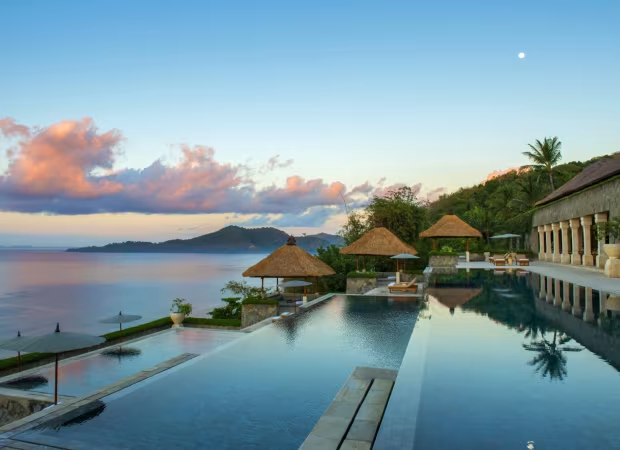
Our take: Amankila is Aman at its most poetic: perched above the Lombok Strait on Bali’s quieter east coast, with a private stretch of coastline and that signature sense of distance from the “scene.” This is the kind of place where silence feels curated—ocean, breeze, ritual—rather than empty. If you want Bali without the noise, this is the cheat code: the energy is softer, the pace is slower, and the luxury is built around privacy, not performance.
Discover our full Bali guide with our favorite gems: restaurants, visits, hotel and more!
Reschio, Umbria

Our take: Reschio isn’t just a hotel—it’s a world. A vast private estate of woodland and meadows, anchored by a meticulously restored castle with a very particular sensibility: lived-in heritage, design intelligence, and a deep respect for atmosphere. The quiet here isn’t accidental; it’s the result of scale (space), intention (restoration done properly), and a setting that naturally dampens the volume of life. It’s the kind of place where you start speaking more softly without noticing.
Cuixmala, Mexico

Our take: Cuixmala is quiet luxury in its most sunlit, untamed form—set within a 30,000-acre nature reserve on Mexico’s Pacific coast, originally conceived as an ultra-private retreat and still carrying that “protected world” feeling. The experience is about immersion: open air, authentic design, wildlife, coastline, and the sense that you’re staying inside a landscape rather than visiting it. It’s one of those rare places where nature does the flexing and you just get to exist inside it.
Estelle Manor, Oxfordshire

Our take: Estelle Manor is a country estate reimagined for modern luxury—playful and beautifully done, but what makes it a quiet-luxury contender is how complete it feels: multiple restaurants, acres of grounds, and a 3,000 sq metre Roman-inspired bathhouse set in woodland where time is meant to slow down. It’s not “silent” in a monastic way; it’s more like controlled privacy—space to disappear, reset, and re-emerge when you feel like it, which is exactly what the best contemporary luxury is selling.